


Paranormal Pursuit at Bingham-Waggoner Estate
Some places don’t need a ghost story to give you chills. Their history does that all on its own.
The Bingham-Waggoner Estate has stood witness to nearly 175 years of Independence history. Thousands of westward travelers passed across this land. The Civil War reached its doorstep. Generations lived—and died—within its walls. Today, some visitors and paranormal investigators believe pieces of that past may still linger.

This fall, discover the stories for yourself as Bingham-Waggoner Estate joins the stops on Visit Independence’s Paranormal Pursuit Passport.
A House With Stories to Tell
The estate’s story stretches back to 1852, when a six-room home was built on land once crossed by pioneers heading west from Independence.
One of its most notable residents arrived in 1864. Artist and politician George Caleb Bingham lived here with his wife, Eliza, and son until 1870. In a studio on the property—space that had formerly served as quarters for enslaved people—Bingham created his famous painting Order No. 11, his response to the forced evacuation of residents from several western Missouri counties during the Civil War.
History was unfolding just beyond the house, too. During the Second Battle of Independence in October 1864, a worker reportedly watched from the second-floor porch as gunfire erupted and soldiers fell nearby.
Long before and after the Civil War, the grounds had a front-row seat to another defining chapter of American history: westward expansion. Thousands of travelers passed through Independence, including members of the Donner Party in 1846.
With so many lives crossing this ground, it’s easy to understand why stories have accumulated here.
Eight Days in the Formal Parlor
One of the estate’s most intriguing stories begins in 1921.
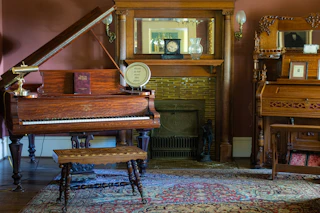
William Waggoner Sr. died that year, and his wake was held inside the mansion’s formal parlor. His body reportedly remained there for eight days.
Home wakes were common during this era. Before funeral homes became the norm, families often cared for the deceased at home, washing and dressing the body before friends and relatives gathered to pay their respects.
The customs surrounding death could be elaborate. Windows might be opened, mirrors covered, clocks stopped, pets kept away and candles kept burning. Some traditions grew from beliefs about spirits and the journey from life to death.
By then, embalming had also become increasingly accepted in America. The practice gained prominence during the Civil War as families sought ways to return fallen soldiers home for burial. Public awareness grew further following the embalming of President Abraham Lincoln.
Imagine standing in Bingham-Waggoner's formal parlor today knowing that, more than a century ago, it served as the setting for eight days of mourning.
And William Waggoner Sr. wasn't the last Waggoner whose life would end at the estate.
Does a Waggoner Still Walk the Halls?
The Waggoner family purchased the property in 1879 and called it home for nearly a century.
Their success in the milling business—including their well-known Queen of the Pantry flour—helped transform the original six-room house into the impressive 26-room mansion visitors see today.
The family's time at the estate ended in 1976 with the death of Harry Waggoner, who died unmarried after spending his life in the family home.
But some believe Harry never completely left.
Visitors and paranormal investigators have reported hearing what sounds like a man's voice or a masculine cough echoing through otherwise empty areas of the mansion. Because Harry was known as a heavy smoker, some have wondered whether the unexplained cough could belong to the estate's final Waggoner resident.
Other reports include shadowy figures seen in the basement and around the grounds.
Then there is the figure said to appear outside after dark.
Who Is the Shadow on the Grounds?
Stories have circulated about the shadowy figure of a man walking the Bingham-Waggoner grounds at night.
Could it be George Caleb Bingham?
Could it be Harry Waggoner?
Or perhaps someone whose name never made it into the history books—a servant, gardener, carriage house worker or one of the countless people whose lives intersected with the property?
There may never be a definitive answer.
Paranormal investigators who have visited the estate have offered different impressions. Some describe the property as relatively calm, while others have reported the distinct feeling that they weren't alone.
That's part of what makes Bingham-Waggoner such an intriguing stop on Paranormal Pursuit. You don't have to believe in ghosts to appreciate the atmosphere. You only have to walk through the rooms and consider everything these walls have witnessed.
Experience Bingham-Waggoner for Yourself
Is the mansion haunted? We'll leave that for you to decide.
This fall, add the Bingham-Waggoner Estate to your Paranormal Pursuit Passport and step into a place where Independence history and unexplained stories meet.
Walk the grounds once crossed by pioneers. Stand near the porch that overlooked a Civil War battle. Enter the rooms where generations of the Bingham and Waggoner families lived their everyday lives—and where some believe echoes of those lives remain.
Then check in, earn your points and continue your pursuit through some of Independence's most storied locations.
Paranormal Pursuit runs September 23–November 6, 2026. With 13 stops throughout Independence, the free digital passport invites you to uncover haunted history, local legends and stories of unexplained encounters while earning points toward prizes along the way.
Are you curious enough to find out what—or who—you might encounter?
Sign up for the Paranormal Pursuit Passport and begin your search at VisitIndependence.com/ParanormalPursuit.